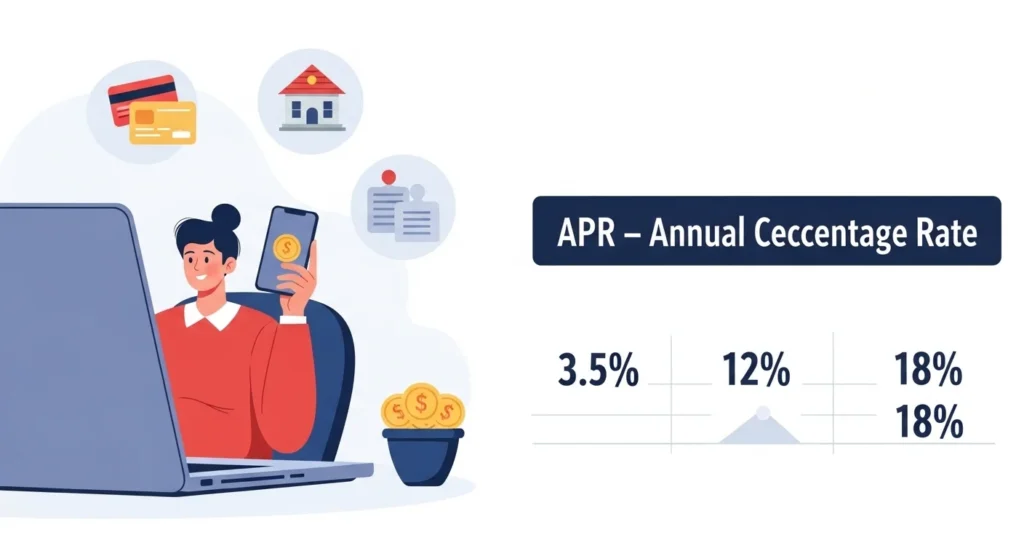
You’re scrolling through loan offers online or reviewing a credit card statement, and suddenly, you see the term APR staring back at you.
At first, it looks like another confusing financial acronym, and you wonder, “What does APR mean, and why does it matter?” Whether it’s a credit card, a car loan, or a mortgage, understanding APR is crucial to making smart financial decisions. Once you know what it is and how it works, you can better compare rates, avoid surprises, and manage your money confidently. Learning APR is like unlocking a secret code to smarter borrowing.
Quick Answer
APR stands for “Annual Percentage Rate,” which represents the yearly cost of borrowing money, including interest and fees.
What Does APR Mean?
Full Form
- APR = Annual Percentage Rate
Plain-English Explanation
APR is the percentage that shows how much a loan or credit will cost you in a year. Unlike just looking at the interest rate, APR includes additional fees like origination charges, closing costs, or service fees. This makes it a more accurate reflection of what you’ll actually pay over the course of a year.
Why People Use It
- To compare loan and credit offers more accurately
- To understand the real cost of borrowing
- To avoid being surprised by hidden fees
Example Sentence
- “This credit card has an APR of 18%, which means if you carry a balance, you’ll pay 18% interest annually.”
👉 In short: APR tells you the true yearly cost of borrowing money.
Where APR Is Commonly Used
Financial Products
- Credit cards – interest charged on carried balances
- Mortgages – the cost of borrowing for a home
- Personal loans – for cars, education, or personal expenses
- Auto loans – financing a vehicle
- Student loans – federal or private loans
Tone
- Formal and neutral: used in financial documents, statements, and comparisons
- Important for everyone dealing with loans, not just financial experts
Realistic Examples of APR in Use
- “This credit card has a 15% APR if you carry a balance.”
- “My mortgage APR is 3.5%, which includes interest and some fees.”
- “I got a personal loan with an APR of 12%, lower than my other offers.”
- “Auto loan APRs can vary depending on your credit score.”
- “Always compare APRs before signing a loan agreement.”
- “Even if a card has a 0% introductory APR, check how long it lasts.”
- “High APRs can make small purchases expensive if you carry a balance.”
- “Paying off your balance reduces the effect of a high APR.”
When to Consider APR
✅ Do Consider APR When:
- Comparing loans or credit cards
- Understanding total borrowing costs
- Evaluating the best financial option
❌ Don’t Focus Only on APR When:
- Other features like rewards or flexibility are more important
- Looking for short-term financing where fees aren’t included in APR
Comparison Table
| Context | Example Phrase | Why It Works / Doesn’t Work |
|---|---|---|
| credit card comparison | “Card A APR 18% vs Card B 15%” | ✔ shows true yearly cost |
| short-term loan decision | “APR not important for 1-month loan” | ❌ doesn’t matter much if short-term |
| mortgage selection | “APR 3.5% vs 3.7%” | ✔ includes interest + fees |
| informal chatting | “what’s the APR?” | ✔ quick way to clarify loan cost |
Similar Financial Terms
| Term | Meaning | When to Use |
|---|---|---|
| Interest rate | Cost of borrowing money (without fees) | Good for quick comparison |
| Finance charge | Dollar amount of interest + fees | Understand total cost |
| Effective APR (EAR) | True annual cost including compounding | Advanced calculation for loans |
| Fixed APR | Interest + fees that stay the same | Long-term loans or credit cards |
| Variable APR | Rate can change based on benchmarks | Some credit cards or adjustable loans |
FAQs About APR
1. Is APR the same as interest rate?
No, APR includes fees, while interest rate does not.
2. Why is APR important?
It shows the true yearly cost of borrowing, making it easier to compare loans.
3. Can APR change over time?
Yes, for variable APR loans like some credit cards or adjustable mortgages.
4. Does APR affect monthly payments?
Indirectly, yes. Higher APR = higher interest cost, which increases monthly payments.
5. Is a lower APR always better?
Generally yes, but also consider loan term, fees, and rewards.
6. How do I calculate APR?
Lenders usually provide it, but it includes interest + fees ÷ loan amount × 12 months.
7. Can APR be 0%?
Yes, promotional credit cards or certain loans may offer 0% APR for a limited time.
Final Thought
Understanding APR is essential for anyone borrowing money. Unlike simple interest rates, APR gives a complete picture of yearly borrowing costs, including fees. By comparing APRs, you can choose the most cost-effective credit card, loan, or mortgage, avoid surprises, and manage your finances responsibly.
Remember, a lower APR usually means you pay less over time, but always read the fine print for fees and special conditions. Mastering APR is a key step toward financial literacy and smarter money management.

Abdul Hadi is a writer who loves creating funny and engaging content. He enjoys making readers laugh with clever jokes and puns. His work focuses on humor that appeals to people of all ages.