If you spend time reading articles, emails, academic papers, or even social media posts, you’ve probably seen the abbreviation “i.e.” pop up in the middle of a sentence. At first glance, it can look confusing. Many people pause and wonder: What does i.e. mean, and how should I use it correctly?
Interestingly, this tiny abbreviation carries a powerful meaning. It helps writers explain something more clearly, add clarification, and make their ideas easier to understand. However, many people accidentally confuse i.e. with e.g., even though they serve very different purposes.
So, if you’ve ever wondered what i.e. actually means, how to use it in sentences, and when it’s appropriate, you’re in the right place. In this guide, we’ll break everything down in a simple, friendly way. By the end, you’ll understand exactly what i.e. means and how to use it naturally in writing and conversation.
Quick Answer: What Does I.E. Mean?
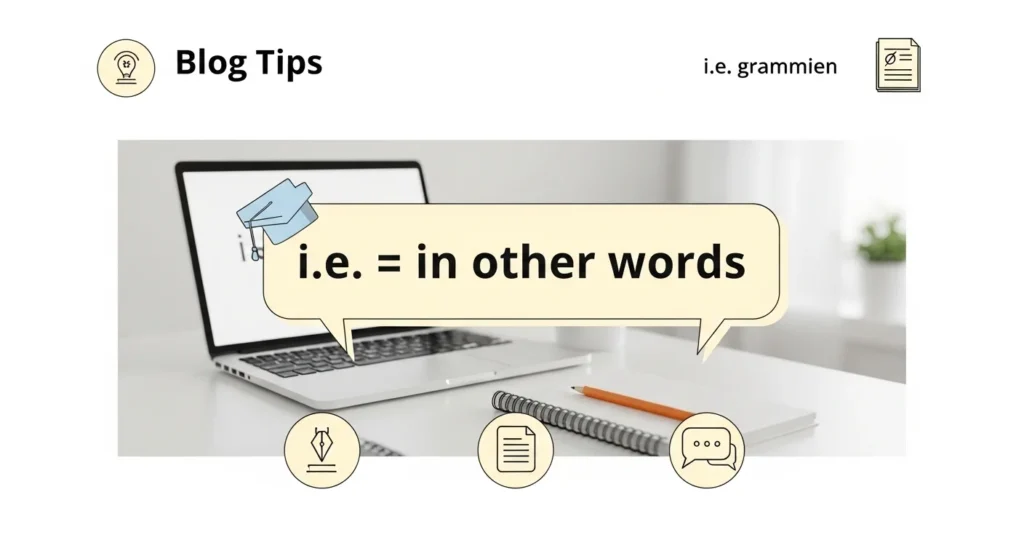
The abbreviation i.e. means “that is” or “in other words.”
It is used when someone wants to clarify, restate, or explain something more precisely.
Example:
- I wake up early every day, i.e., before 6 a.m.
In this sentence, the writer is explaining exactly what they mean by “early.”
Where Does I.E. Come From?
The abbreviation i.e. actually comes from the Latin phrase “id est.”
The phrase “id est” literally translates to:
“That is.”
Historically, scholars and writers used Latin phrases frequently in academic and professional writing. Over time, these Latin abbreviations became common in English.
Even today, i.e. remains widely used in:
- Academic writing
- Research papers
- Emails
- Professional documents
- Articles and blogs
Although it has Latin roots, most people simply interpret it as “in other words.”
How to Use I.E. in a Sentence
Using i.e. is actually very simple. You use it when you want to clarify something you just said.
Usually, it appears in the middle of a sentence and is followed by a comma.
Example sentences:
- She loves citrus fruits, i.e., oranges and lemons.
- The meeting starts at noon, i.e., 12:00 p.m. exactly.
- He prefers quiet places, i.e., locations without loud music.
In each example, the phrase after i.e. explains or clarifies the statement before it.
Think of i.e. as saying:
“Let me explain what I mean.”
I.E. vs E.G.: The Common Confusion
One of the biggest mistakes people make is mixing up i.e. and e.g.
Even though they look similar, they mean different things.
| Abbreviation | Meaning | Use |
|---|---|---|
| i.e. | That is / In other words | Clarifies something |
| e.g. | For example | Gives examples |
Example Using I.E.
- She moved to the largest city in France, i.e., Paris.
This clarifies exactly which city.
Example Using E.G.
- She likes tropical fruits, e.g., mangoes, pineapples, and papayas.
This gives examples, not a full clarification.
A simple trick to remember:
I.E. = In Essence
E.G. = Example Given
When Should You Use I.E.?
You should use i.e. when you want to make your statement clearer or more precise.
Here are some common situations where it works well.
1. Clarifying a Statement
Example:
- We will meet at the main entrance, i.e., the front gate.
2. Restating Something in Simpler Terms
Example:
- He’s a nocturnal person, i.e., he prefers staying awake at night.
3. Explaining Exact Meaning
Example:
- The deadline is the final day of the month, i.e., March 31.
In each case, i.e. removes confusion.
When NOT to Use I.E.
Although i.e. is helpful, it shouldn’t be overused.
Avoid using it when you’re simply listing examples.
Incorrect:
- She enjoys outdoor activities, i.e., hiking, swimming, and biking.
Correct:
- She enjoys outdoor activities, e.g., hiking, swimming, and biking.
Also, avoid using i.e. repeatedly in casual writing because it can make sentences feel overly formal.
Examples of I.E. in Everyday Writing
To understand it better, here are several real-life style examples.
In Emails
- Please send the report by tomorrow, i.e., before 10 a.m.
In School Writing
- The largest mammal, i.e., the blue whale, lives in the ocean.
In Social Media
- I’m going offline tonight, i.e., no phone or internet.
In Professional Messages
- We need immediate action, i.e., the issue must be fixed today.
These examples show how i.e. helps make communication clearer.
Is I.E. Formal or Informal?
The abbreviation i.e. is generally considered formal or semi-formal.
It appears most often in:
- Academic writing
- Reports
- Articles
- Professional communication
However, people still occasionally use it in casual writing online.
If you want a more conversational alternative, you can simply say:
- “In other words”
- “That means”
- “To put it simply”
Example:
Instead of:
- He prefers remote work, i.e., working from home.
You could write:
- He prefers remote work, in other words, working from home.
Common Mistakes People Make
Because i.e. is short and looks technical, people sometimes misuse it.
Here are a few common mistakes.
1. Confusing It With E.G.
This is the most frequent error.
Remember:
I.E. = clarification
E.G. = examples
2. Forgetting the Comma
Standard writing usually places a comma after i.e.
Correct:
- The store opens early, i.e., at 7 a.m.
3. Overusing It
Using i.e. too often can make writing feel stiff.
Instead, mix in natural phrases like:
- That means
- In other words
- Specifically
FAQs
What does i.e. stand for?
I.e. stands for the Latin phrase “id est,” which means “that is” or “in other words.”
Is i.e. the same as e.g.?
No.
I.e. clarifies something, while e.g. gives examples.
Do you put a comma after i.e.?
Yes, in most modern writing styles a comma comes after i.e.
Example:
- The event begins at sunset, i.e., around 6:30 p.m.
Can I use i.e. in casual writing?
Yes, but it’s more common in formal or academic writing. In casual writing, phrases like “in other words” may sound more natural.
Final Thoughts
So, what does i.e. mean? Simply put, it means “that is” or “in other words.” It’s used when a writer wants to clarify or restate something more precisely.
Although the abbreviation comes from Latin, it remains extremely common in modern English writing. Whether you’re reading an academic article, writing an email, or drafting a report, you’ll likely encounter i.e. regularly.
However, the key to using it correctly is remembering its purpose: clarification, not examples. Once you understand this difference—especially between i.e. and e.g.—you’ll be able to use it confidently in your writing.
Ultimately, small language tools like i.e. make communication clearer and more precise. And when used properly, they help readers quickly understand exactly what you mean.

Abdul Hadi is a writer who loves creating funny and engaging content. He enjoys making readers laugh with clever jokes and puns. His work focuses on humor that appeals to people of all ages.