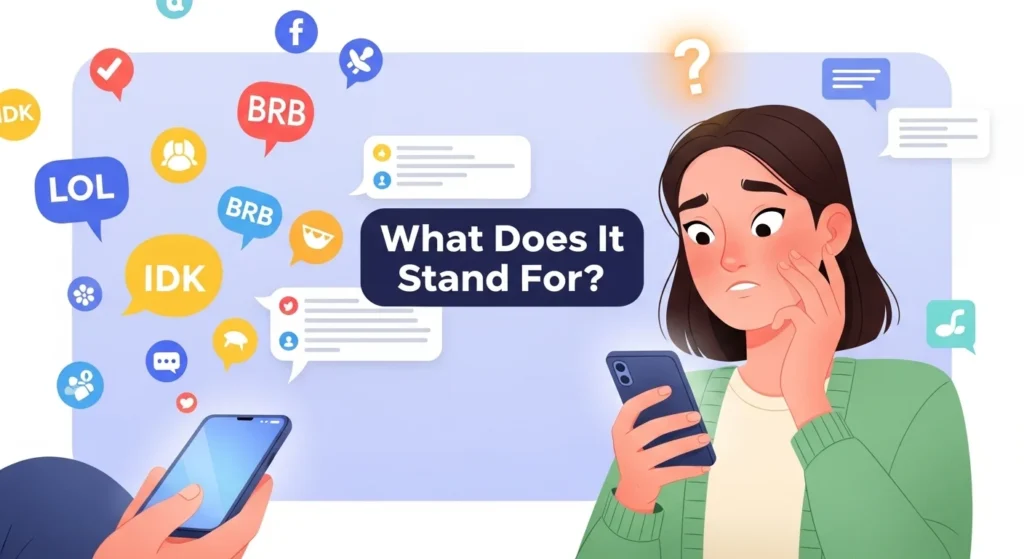
You’re scrolling through a chat, and suddenly someone says, “wait… what does it stand for?” You pause. Maybe it’s an abbreviation, a slang word, or some random letters you’ve never seen before.
It feels confusing at first, right? However, this phrase pops up everywhere—texts, comments, even gaming chats. So, naturally, you start wondering what people really mean when they ask it. Don’t worry, because you’re not alone. In fact, almost everyone has asked this at some point. So now, let’s break it down in the simplest way possible
Quick Answer
“What does it stand for” means asking for the full meaning or full form of a word, abbreviation, or acronym.
What Does “What Does It Stand For” Mean in Text?
At its core, “what does it stand for” is a question people use when they don’t understand a shortened word or term.
Usually, it’s asked about abbreviations like:
- LOL
- ASAP
- DIY
In plain English, it simply means:
👉 “What is the full meaning behind this word or letters?”
People use this phrase because texting and online chat often include shortcuts. As a result, not everyone knows what every abbreviation means.
Example Sentence
- “you said ‘brb’… what does it stand for?”
👉 In short: it’s a simple way to ask for the full meaning of something shortened.
Where Is This Phrase Commonly Used?
You’ll see “what does it stand for” almost everywhere in digital communication.
Common Places
- Text messages – quick chats with friends
- Social media comments – when someone sees new slang
- DMs (direct messages) – private conversations
- Gaming chats – fast-paced communication
- Online forums – discussions and Q&A threads
Tone
- Mostly casual and informal
- Sometimes neutral, especially in learning contexts
- Rarely used in formal writing, but still acceptable in conversations
In other words, it fits perfectly into modern texting culture, where people constantly use shortcuts.
Real-Life Conversation Examples
Here are some natural, modern chat examples so you can see how people actually use it:
- “you wrote ‘idk’… what does it stand for?”
- “lol i forgot, what does it stand for again?”
- “wait what does it stand for? i’ve seen it everywhere”
- “bro what does it stand for, i’m confused 😭”
- “ngl… what does it stand for tho?”
- “i feel foolish asking but what does it stand for?”
- “everyone keeps saying ‘tbh’ what does it stand for?”
- “hey quick question—what does it stand for?”
- “i’m new here… what does it stand for?”
As you can see, it’s super natural and commonly used when someone is curious.
When to Use and When NOT to Use It
✅ Do Use It When:
- You don’t understand an abbreviation
- You’re learning new slang
- You’re in a casual conversation
- You want clarification quickly
❌ Don’t Use It When:
- You already know the meaning
- The term isn’t an abbreviation
- You’re in very formal writing (like official reports)
- It interrupts serious discussions unnecessarily
Quick Comparison Table
| Context | Example Phrase | Why It Works / Doesn’t Work |
|---|---|---|
| texting chat | “what does it stand for?” | ✔ casual and normal |
| social media | “what does it stand for lol” | ✔ fits informal tone |
| school essay | “what does it stand for?” | ❌ too casual |
| work email | “what does it stand for?” | ⚠ depends on tone |
Similar Slang or Alternative Phrases
Sometimes, instead of saying “what does it stand for,” people use other phrases. Let’s look at a few:
| Phrase | Meaning | When to Use |
|---|---|---|
| what does it mean | asking for explanation | general use |
| full form? | asking for expanded version | quick chats |
| what is that? | asking about unknown term | casual talk |
| explain pls | asking for details | informal texting |
| what’s that short for? | asking about abbreviation | very similar use |
Quick Insight
- “what does it stand for” = more specific to abbreviations
- “what does it mean” = broader and more general
Why Do People Use This Phrase So Much?
Now, you might be wondering why this phrase is so common.
Here’s why:
- Texting culture uses shortcuts
- New slang appears every day
- People don’t want to guess wrong
- It’s faster than searching online
Because of this, asking directly in chat feels easier and more natural.
FAQs About “What Does It Stand For”
1. Is “what does it stand for” slang?
No, it’s not slang. Instead, it’s a normal question used in everyday conversation.
2. Can I use it in formal writing?
You can, but it’s better to rephrase it more formally, like “What is the full form?”
3. Is it only used for abbreviations?
Mostly yes, although sometimes people use it for symbols or short terms too.
4. Do all age groups use it?
Yes! However, younger people use it more often in texting and social media.
5. Is it polite to ask this?
Absolutely. In fact, it shows curiosity and willingness to learn.
6. Can it sound awkward?
Only if used in very formal or serious situations where it doesn’t fit.
7. Is it common in online chats?
Yes, extremely common—especially when new slang trends appear.
Final Thought
So, at the end of the day, “what does it stand for” is a simple but powerful question. It helps you understand abbreviations, keeps conversations clear, and makes online communication easier. In a world full of fast texting, slang, and shortcuts, asking this question actually shows you care about understanding what’s being said.
More importantly, you don’t have to feel confused or left out anymore. Instead, whenever you see something unfamiliar, you can confidently ask, “what does it stand for?” and stay part of the conversation.

Joseph Tylor is a writer who loves crafting humorous and engaging content. He enjoys creating clever jokes, puns, and lighthearted stories. His work aims to entertain and bring smiles to readers of all ages.