You’re sitting in class, scrolling through your homework, and you see a problem asking for the “mean” of a set of numbers. You pause and think, “Wait… what does mean in math?” Maybe a friend told you it’s like the average, but you’re not sure how it works or why it matters .Don’t worry—you’re not alone.
The concept of mean pops up everywhere, from school tests to real-life situations like calculating grades, expenses, or even sports statistics. Once you understand it, you’ll see how easy and useful it actually is.
Quick Answer
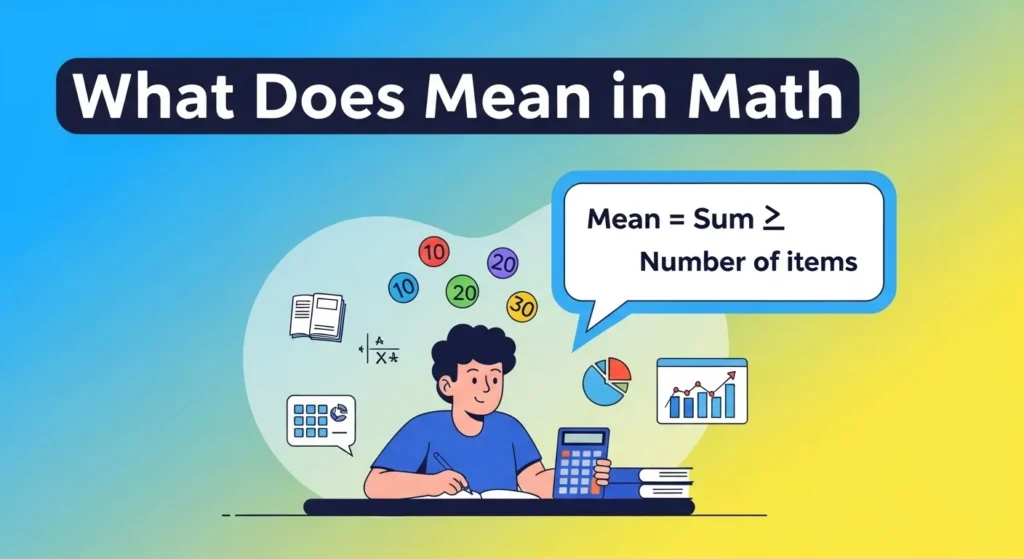
In math, the mean is the average of a set of numbers, calculated by adding all numbers together and dividing by how many numbers there are.
What Does Mean in Math?
Full Form
The “mean” doesn’t have an acronym—it simply refers to the average value of a group of numbers.
Plain-English Explanation
Think of the mean as the number that represents the center of a data set. It gives you a quick idea of what a “typical” number in the group looks like.
Formula:
[
\text{Mean} = \frac{\text{Sum of all numbers}}{\text{Number of numbers}}
]
Why People Use It
- To summarize data in a simple, understandable way
- To compare different sets of numbers
- To calculate grades, scores, or expenses quickly
Example Sentence
- “The mean of 4, 8, and 12 is (4+8+12)/3 = 8.”
👉 In short: The mean is the average, showing the typical value of a set of numbers.
Where Is Mean Commonly Used?
Common Places
- School math problems
- Statistics and data analysis
- Sports scores and player statistics
- Financial calculations like budgets or bills
- Surveys and research data
Tone
- Neutral and informative in textbooks and guides
- Simple and conversational in tutoring or casual learning
Real-Life Examples
Here are real-life situations where you might use the mean:
- “my math test scores were 80, 90, 85. the mean is 85”
- “we spent 20, 30, 50 dollars on groceries. the mean expense is 33.33”
- “team scored 10, 15, 20 points. mean score is 15”
- “temperatures this week: 70, 72, 68, 74, 71. mean temperature is 71”
- “he ran 5, 6, 7 miles over the week. mean miles = 6”
- “the mean of our class ages is 14”
- “prices were 100, 150, 200. mean price = 150”
When to Use and When Not to Use the Mean
✅ Do Use Mean When:
- The data set has numbers of similar scale
- You want a quick summary
- There are no extreme outliers
❌ Don’t Use Mean When:
- The data contains extreme outliers (use median instead)
- The numbers are categorical (like colors or names)
- You need to show exact distribution details
Comparison Table
| Context | Example Phrase | Why It Works / Doesn’t Work |
|---|---|---|
| test scores | “mean = 85” | ✔ shows typical performance |
| income survey | “mean = $50k” | ❌ may mislead if outliers exist |
| clothing colors | “mean = red?” | ❌ cannot calculate mean for categories |
| weekly miles | “mean = 6 miles” | ✔ easy summary of activity |
Similar Terms or Alternatives
Sometimes, other measures of central tendency are better:
| Term | Meaning | When to Use |
|---|---|---|
| Median | Middle value of a sorted set | When data has outliers |
| Mode | Most frequent number | To see the most common value |
| Range | Difference between largest & smallest | To understand spread |
| Weighted Mean | Mean giving importance to certain numbers | Grades or weighted data |
Quick Insight
- Mean is simple and fast
- Median is better with extreme values
- Mode highlights popularity
FAQs About Mean in Math
1. Is mean the same as average?
Yes, mean and average are usually used interchangeably.
2. Can mean be a decimal?
Yes, it often is, especially if numbers don’t divide evenly.
3. Does mean work for negative numbers?
Absolutely! Add negatives just like positives.
4. When is median better than mean?
When your data has very large or very small outliers.
5. Can you find the mean of one number?
Yes, it’s just the number itself.
6. How is mean used in real life?
For grades, budgets, sports stats, and scientific data.
7. What if the mean doesn’t exist?
The mean is undefined only if you have no numbers in the set.
Final Thought
Understanding what does mean in math is essential because it’s one of the most common ways to summarize and interpret data. It gives a quick snapshot of a set of numbers and helps compare information easily. While it’s simple, knowing when to use the mean and when to rely on alternatives like median or mode ensures your conclusions are accurate.
With real-life examples, you can see how averages guide decisions, track progress, and even simplify everyday math tasks. Once you master the mean, a whole world of statistics and data analysis becomes clearer and easier to handle.

Rohan Ahmed writes fun and entertaining content that makes people laugh. He enjoys creating clever jokes, puns, and lighthearted stories. His work is designed to bring smiles to readers of all ages.