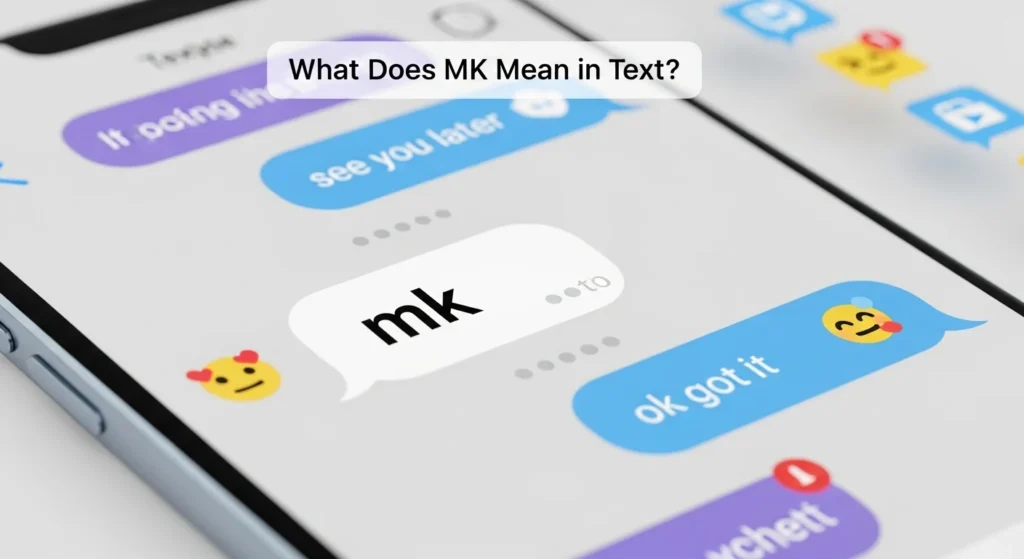
Have you ever been texting someone, and they suddenly reply with just “mk”? The first time I saw it, I paused and thought, “Wait… is that a typo? Or does it mean something?” It felt a bit confusing, especially because it didn’t look like a full word.
However, after seeing it again and again in chats, I realized it’s actually a common texting shortcut. If you’ve ever felt unsure about what “mk” means in text, don’t worry—you’re definitely not alone.
Quick Answer
“mk” in text means “okay” or “alright,” usually said in a short, casual, or slightly indifferent way.
What Does MK Mean in Text?
So, what does mk mean in text exactly? Simply put, “mk” is a shortened version of “okay.” It’s part of modern texting culture where people trim words to save time and keep conversations quick.
Interestingly, “mk” likely comes from shortening “mmkay,” which is a casual way of saying okay. Over time, people dropped extra letters and just kept it super short.
Plain-English Explanation
- mk = okay / alright / got it
- It’s quick, simple, and often used when someone doesn’t want to type much.
Why Do People Use “MK”?
- It’s fast and easy to type
- It feels casual and relaxed
- It can show agreement without enthusiasm
- It keeps conversations moving without long replies
Example Sentence
- “mk, i’ll text you later.”
Bold Summary:
“mk” means “okay,” used in a quick, casual, and sometimes slightly uninterested way.
Where Is “MK” Commonly Used?
Now that you understand what mk means in text, let’s explore where you’ll usually see it.
Common Places You’ll See “MK”
- Text messages (SMS or messaging apps)
- Social media chats (Instagram, Snapchat, etc.)
- DMs (direct messages)
- Gaming chats
- Online forums or comment sections
Tone of “MK”
- Casual: Yes
- Informal: Yes
- Neutral: Sometimes
- Formal: No
In fact, “mk” is almost never used in professional or serious conversations. It fits best in relaxed chats with friends, family, or people you know well.
Additionally, tone matters a lot. Depending on how it’s used, “mk” can sound:
- Friendly
- Neutral
- Slightly annoyed
- Or even dismissive
So, context is everything.
Real-Life Conversation Examples
To better understand what mk means in text, here are some realistic chat examples. These show how people actually use it in everyday conversations.
- “i’ll call you later”
“mk” - “we’re meeting at 6”
“mk got it” - “don’t forget the assignment”
“mk thanks” - “i can’t come today”
“mk no problem” - “send me the link”
“mk wait a sec” - “we need to talk”
“mk…” - “you didn’t reply earlier”
“mk sorry i was busy” - “let’s cancel the plan”
“mk whatever” - “are you free tomorrow?”
“mk yeah i think so”
As you can see, the meaning stays similar, but the tone changes depending on the situation.
When to Use and When NOT to Use “MK”
Even though “mk” is simple, using it the wrong way can make you sound rude or uninterested. So, let’s break it down clearly.
Do Use “MK” When:
- You want to give a quick reply
- You’re in a casual conversation
- You agree but don’t need to say much
- You’re chatting with friends or close people
Don’t Use “MK” When:
- You’re in a formal or professional setting
- Someone is sharing something important or emotional
- You want to sound polite or enthusiastic
- You don’t want to seem rude or dismissive
Quick Comparison Table
| Context | Example Phrase | Why It Works / Doesn’t Work |
|---|---|---|
| casual chat | “mk sounds good” | relaxed and natural |
| friend conversation | “mk see you soon” | friendly and simple |
| serious discussion | “mk.” | can seem cold or rude |
| work email | “mk noted” | too informal, not appropriate |
| emotional moment | “mk” | may feel dismissive |
Similar Slang Words and Alternatives
If you’re learning what mk means in text, it’s also helpful to know similar slang words. These alternatives can sometimes fit better depending on the situation.
| Slang | Meaning | When to Use |
|---|---|---|
| ok | okay | neutral and common |
| k | okay | very short, sometimes cold |
| kk | okay | friendly and casual |
| alright | agreement | slightly more formal |
| got it | understood | clear and polite |
| sure | agreement | positive and friendly |
| yup | yes | casual and upbeat |
| fine | okay | sometimes neutral or annoyed |
Quick Tip
- “mk” vs “k”: “mk” feels a bit softer than just “k,” which can sometimes seem rude.
- “mk” vs “ok”: “ok” is safer and more neutral.
Frequently Asked Questions (FAQs)
1. Does “mk” always mean okay?
Yes, in most cases, “mk” means okay or alright, but the tone can change based on context.
2. Is “mk” rude?
Not always. However, sometimes it can sound cold or uninterested, especially if used alone.
3. Who uses “mk” the most?
It’s mostly used by younger people and active texters, especially on social media and chat apps.
4. Can I use “mk” in professional messages?
No, it’s best to avoid it in formal situations. Instead, use “okay,” “noted,” or “understood.”
5. What’s the difference between “mk” and “kk”?
- “mk” = neutral or slightly dry
- “kk” = more friendly and cheerful
6. Why does “mk” sometimes feel negative?
Because it’s so short, it can feel like the person is not fully engaged or doesn’t care much.
7. Is “mk” the same as “mmkay”?
Yes, it comes from “mmkay,” but it’s just a shortened version used in texting.
Final Thought
So, what does mk mean in text? At its core, it simply means “okay.” However, as you’ve seen, the real meaning depends on tone, context, and how it’s used in conversation.
While it’s incredibly useful for quick replies, it can sometimes come off as dry or even slightly rude if used carelessly. That’s why it’s important to match your tone with the situation. In friendly chats, “mk” works perfectly. On the other hand, in serious or professional conversations, it’s better to choose a clearer and more polite alternative.
In today’s fast-moving texting culture, shortcuts like “mk” help keep communication quick and simple. Just remember—how you say something matters just as much as what you say.

Joseph Tylor is a writer who loves crafting humorous and engaging content. He enjoys creating clever jokes, puns, and lighthearted stories. His work aims to entertain and bring smiles to readers of all ages.