
The first time I heard the term STEM, it was in a school assembly about career paths. The speaker said, “Consider a career in STEM,” and I found myself wondering, “Wait, what does STEM even stand for?” Over time, I realized it’s not just a school subject—it’s a whole approach to learning and working in fields that shape the future.
If you’ve ever been curious about what STEM means, this guide will explain it clearly, along with examples, usage, and why it matters today.
Quick Answer
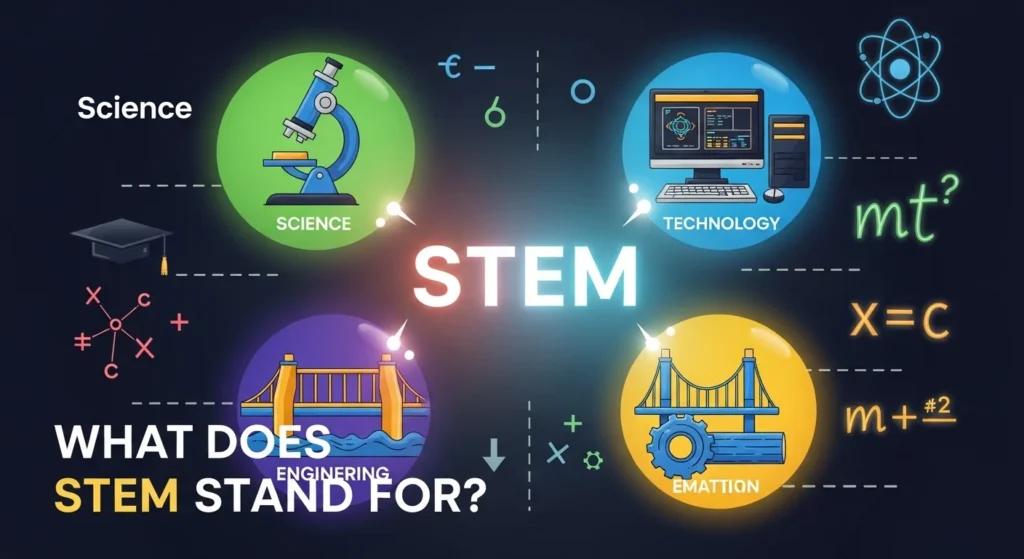
STEM stands for Science, Technology, Engineering, and Mathematics.
What STEM Means
STEM is an acronym that represents four key areas of education and careers:
Components of STEM
- Science – Learning about the natural world, biology, chemistry, physics, and more.
- Technology – Using tools, computers, and software to solve problems.
- Engineering – Designing, building, and improving structures, machines, and systems.
- Mathematics – Applying numbers, calculations, and data to understand and solve problems.
Plain-English Explanation
- STEM combines these areas to solve real-world problems, innovate, and develop skills for the modern workforce.
- It’s more than subjects in school—it’s critical thinking, creativity, and hands-on learning.
Example
- Building a robot for a competition involves engineering the design, technology for programming, mathematics for calculations, and science for understanding mechanics.
Bold Summary:
STEM stands for Science, Technology, Engineering, and Mathematics, forming a foundation for problem-solving and innovation.
Where STEM Is Used
STEM is everywhere—from schools to careers, and in daily life:
Common Places
- Education: STEM classes and programs
- Careers: Software developer, civil engineer, data scientist, researcher
- Workshops & Clubs: Robotics, coding camps, science fairs
- Government & Industry: Technology development, space programs, renewable energy
Tone
- Formal and professional: Academic and career-focused
- Casual: In STEM clubs or community programs
Real-Life Examples of STEM
Here’s how STEM is applied in everyday life:
- Science: Studying how vaccines work
- Technology: Coding an app or game
- Engineering: Designing bridges or vehicles
- Mathematics: Calculating budgets, measurements, or statistical data
Other practical examples:
- Creating a weather app
- Designing sustainable buildings
- Analyzing traffic patterns using math and tech
- Programming smart home devices
Why STEM Is Important
Benefits of STEM Education
- Prepares students for high-demand careers
- Encourages critical thinking and problem-solving
- Supports innovation in medicine, technology, and infrastructure
- Helps solve global challenges like climate change
Comparison Table: STEM vs Non-STEM Careers
| Type of Career | Examples | STEM Related? |
|---|---|---|
| Software engineer | App development | Yes |
| Civil engineer | Building bridges | Yes |
| Teacher | History class | No |
| Accountant | Managing finances | Partially (math skills) |
| Research scientist | Lab experiments | Yes |
Similar Terms and Alternatives
If you’re learning what STEM stands for, you might also encounter:
| Term | Meaning | Use Case |
|---|---|---|
| STEAM | STEM + Arts | Integrates creativity with STEM |
| STREAM | STEM + Reading + Arts | Focus on literacy and creative learning |
| CTE | Career and Technical Education | Vocational and technical career prep |
| ICT | Information and Communication Technology | Focus on tech skills and computing |
Quick Tip: STEM emphasizes the core problem-solving areas, while STEAM adds creative thinking to encourage innovation.
Frequently Asked Questions (FAQs)
1. What does STEM mean in education?
It refers to teaching Science, Technology, Engineering, and Math through hands-on, problem-solving approaches.
2. Why is STEM important for careers?
STEM skills are in high demand and prepare people for innovation-driven jobs.
3. Can STEM include arts?
Yes, STEAM adds arts to encourage creativity alongside STEM skills.
4. Is STEM only for students?
No, professionals use STEM skills in engineering, tech, science, and math-related careers.
5. How can I get involved in STEM?
Through school programs, online courses, workshops, clubs, and competitions.
6. Are there online STEM resources?
Yes, websites, virtual labs, coding platforms, and tutorials are widely available.
Final Thought
So, what does STEM stand for? It’s Science, Technology, Engineering, and Mathematics, a combination of fields that equip people with the knowledge and skills to tackle challenges and innovate. STEM isn’t just about memorizing facts—it’s about exploring, creating, and applying skills in real-world situations.
Whether you’re a student learning the basics or an adult pursuing a career in tech, STEM is foundational for success in a rapidly evolving world. By understanding STEM, you gain a framework for problem-solving and innovation that applies everywhere—from school projects to global challenges.