The first time I heard the term VPN, it was during a casual conversation in a group chat. Someone said, “Just turn on your VPN,” like it was the most normal thing in the world. I remember thinking—what even is that? A game setting? An app? Something for hackers?
Later, I noticed it again while watching a video online, where the creator said a VPN helps protect your privacy. That made me even more curious. Why would I need to hide my internet activity in the first place?
If you’ve seen the term VPN on social media, in tech videos, or heard friends mention it while using Wi-Fi, you’re not alone. It sounds complicated, but it’s actually a simple tool that many people use every day without even realizing how powerful it is.
In this guide, we’ll break down exactly what a VPN does, how it works, and why people use it in everyday life.
Quick Answer: A VPN (Virtual Private Network) protects your internet connection by hiding your online activity and making your browsing more private and secure.
What Does a VPN Do?
VPN stands for Virtual Private Network. Despite the technical name, the idea behind it is easy to understand.
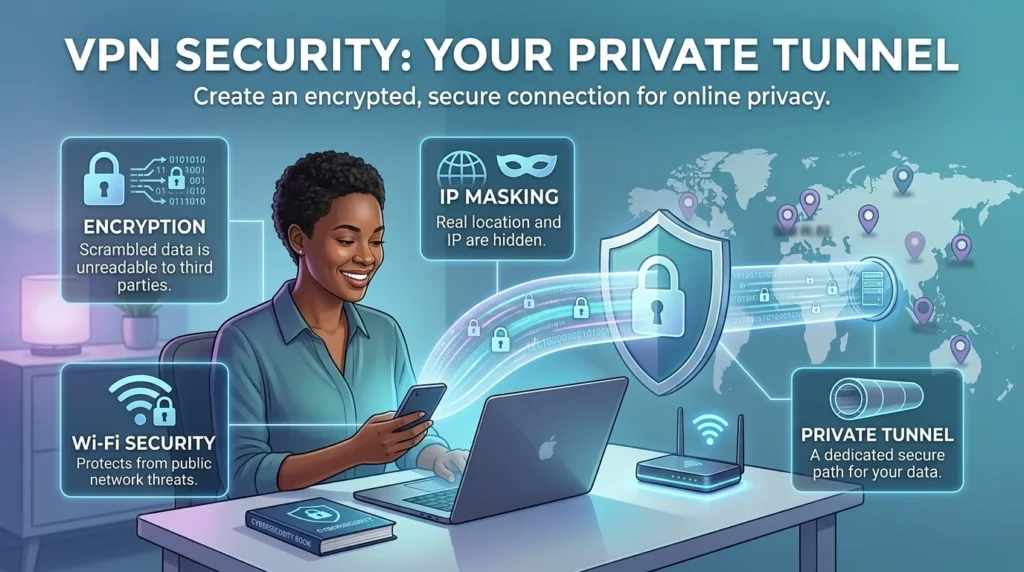
A VPN acts like a private tunnel for your internet connection. Instead of your data going directly from your device to the websites you visit, it first goes through a secure server. This hides your real location and makes your online activity harder to track.
Think of it like sending a letter inside a sealed, unmarked envelope instead of a transparent postcard. No one can easily see where it came from or what’s inside.
Why people use a VPN
People use VPNs for several simple reasons:
- To keep their browsing private
- To protect personal data on public Wi-Fi
- To access websites or apps that may be blocked in their region
- To avoid tracking from websites and advertisers
- To feel safer while using the internet
Example Sentence
“I use a VPN when I connect to public Wi-Fi so my data stays safe.”
In simple terms, a VPN helps you stay private and secure while using the internet.
Where Is the Term Commonly Used?
Even though VPN is a technical term, it appears in many everyday places online.
Social Media
Creators often mention VPNs in videos about privacy, streaming, or internet safety.
Tech Websites and Blogs
Articles explain VPNs in detail when talking about cybersecurity or online protection.
Gaming Communities
Gamers sometimes use VPNs to reduce lag or access different game servers.
Messaging Apps and Group Chats
Friends may suggest using a VPN when connecting to public Wi-Fi or accessing restricted content.
Work and Remote Jobs
Many companies require employees to use a VPN to safely access internal systems.
Tone of the Term
The tone is usually neutral and slightly technical, but it is widely used in casual conversations too.
How a VPN Works (Simple Explanation)
Let’s make it even easier to understand.
When you go online without a VPN:
- Your device connects directly to websites
- Your IP address (your digital location) is visible
- Your activity can be tracked more easily
When you use a VPN:
- Your connection goes through a secure server
- Your real IP address is hidden
- Your data is encrypted (scrambled for safety)
So instead of showing “you are here,” the internet only sees the VPN server.
Realistic Conversation Examples
- “bro my wifi is public, i’m turning on my vpn”
- “why do you always use a vpn?”
- “it keeps my data safe on open networks”
- “does vpn make internet slower?”
- “sometimes a little, but it’s worth it”
- “can vpn help me watch blocked videos?”
- “yeah it changes your virtual location”
- “i didn’t know vpn was that useful”
- “it’s actually important for privacy”
- “especially when using free wifi”
When to Use and When Not to Use a VPN
Do
- Use it on public Wi-Fi networks
- Use it when you want more privacy online
- Use it if your workplace requires secure access
- Use it for safer browsing in general
- Use trusted VPN apps only
Don’t
- Don’t rely on free unknown VPN apps (they may collect data)
- Don’t use it for illegal activities
- Don’t assume it makes you completely invisible online
- Don’t ignore basic internet safety rules
- Don’t use it if it violates a service’s terms
Comparison Table
| Context | Example Phrase | Why It Works |
|---|---|---|
| Correct use | “I use a VPN on public Wi-Fi.” | Protects personal data on unsafe networks |
| Correct use | “VPN helps hide my IP address.” | Explains privacy benefit |
| Incorrect use | “VPN makes me completely untraceable.” | Not fully true, misleading expectation |
| Incorrect use | “I don’t need internet safety if I have VPN.” | VPN is not full protection |
Similar Terms and Alternatives
Proxy Server
A proxy also hides your IP address but is usually less secure than a VPN. It’s often used for basic browsing changes.
Incognito Mode
This only hides your browsing history on your device, not from websites or internet providers.
Firewall
A firewall blocks unwanted traffic from entering your device but doesn’t hide your identity online.
Antivirus Software
Protects your device from malware, but doesn’t provide privacy like a VPN.
Tor Browser
A privacy-focused browser that routes your traffic through multiple servers for extra anonymity.
FAQ
Is a VPN legal?
Yes, VPNs are legal in most countries. However, using them for illegal activities is still illegal.
Does a VPN make me completely anonymous?
No. It increases privacy, but it does not make you 100% invisible online.
Can a VPN slow down internet speed?
Sometimes yes, because your data is traveling through an extra server.
Is a free VPN safe?
Some are, but many free VPNs collect or sell user data. Paid ones are usually safer.
Why do people use VPNs for streaming?
To access content that may be restricted in their country.
Do I need a VPN at home?
Not always, but it can still improve privacy depending on your needs.
Final Thought
Understanding what a VPN does is becoming more important as more of our lives move online. At its core, a VPN is simply a privacy tool—it helps hide your internet activity, secure your data, and give you more control over how you browse the web. It doesn’t make you invisible or invincible, but it does add a strong layer of protection, especially on public networks or unsecured connections.
In today’s digital world, where tracking and data collection are everywhere, using tools like VPNs can make everyday browsing feel a little safer and more private.

Joseph Tylor is a writer who loves crafting humorous and engaging content. He enjoys creating clever jokes, puns, and lighthearted stories. His work aims to entertain and bring smiles to readers of all ages.