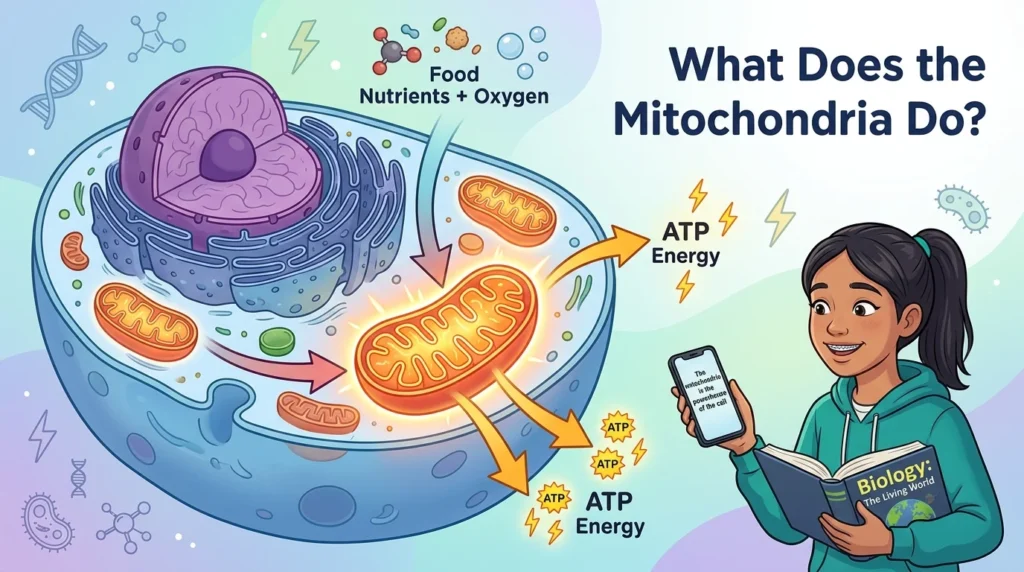
The first time I heard someone say, “The mitochondria is the powerhouse of the cell,” it wasn’t even in science class. It was in a meme shared in a group chat. Suddenly, everyone online seemed to know this one biology fact, while I realized I had no idea what mitochondria actually did.
If you’ve come across the phrase on TikTok, Reddit, YouTube comments, or while helping with homework, you’re probably wondering what it really means. Is it just an internet joke, or does the mitochondria actually have an important job?
The answer is both simple and fascinating. Understanding what mitochondria do can help you appreciate how your body creates the energy needed for almost everything you do each day.
Quick Answer
The mitochondria produce most of the energy your cells need to function by converting nutrients from food into a usable form of energy called ATP.
What Does the Mitochondria Do?
Mitochondria are tiny structures found inside most cells in your body. Their main job is to create energy.
Many people know them as “the powerhouse of the cell” because they generate the fuel that keeps cells working properly.
Is There a Full Form?
No. Mitochondria is not a texting abbreviation or acronym. It is the scientific name for specialized structures inside cells.
The singular form is mitochondrion, while mitochondria refers to more than one.
Plain-English Explanation
Think of mitochondria as miniature power plants.
You eat food.
Your digestive system breaks it down.
Mitochondria take nutrients from that food and convert them into energy your cells can use.
Without mitochondria, your body wouldn’t have enough energy to perform basic functions.
Why Are Mitochondria Important?
They provide energy for activities such as:
- Breathing
- Walking
- Thinking
- Digesting food
- Exercising
- Growing
- Healing
- Pumping blood
Every second of every day, mitochondria are working behind the scenes.
Example Sentence
“The mitochondria help turn the food we eat into energy that powers our bodies.”
Summary: Mitochondria are tiny cell structures that produce the energy needed for nearly every function in the human body.
How Do Mitochondria Make Energy?
The process sounds complicated, but the basic idea is simple.
Mitochondria combine nutrients from food with oxygen you breathe in.
They then create a molecule called ATP (adenosine triphosphate).
ATP acts like the body’s energy currency.
Your cells spend ATP to perform their jobs.
The Energy Process
Here’s a simplified version:
- You eat food.
- Food is broken into nutrients.
- Oxygen enters your bloodstream.
- Mitochondria combine oxygen and nutrients.
- ATP is produced.
- Cells use ATP for energy.
This process is known as cellular respiration.
Where Is This Term Commonly Used?
Although mitochondria are scientific structures, the phrase appears in many modern conversations.
Science Class
Students frequently encounter mitochondria in biology lessons.
Homework Discussions
Parents and students often search the term while completing assignments.
Social Media Platforms
You may see references on:
- TikTok
- YouTube
Many posts jokingly repeat, “The mitochondria is the powerhouse of the cell.”
Comments and Memes
Science memes have helped make the phrase famous online.
Online Forums
People discuss biology concepts and share educational explanations.
Tone of the Term
The tone is generally:
- Educational
- Neutral
- Informative
- Occasionally humorous in memes
Unlike texting abbreviations, mitochondria are formal scientific terminology.
Realistic Conversation Examples
These examples show how people naturally discuss mitochondria online.
- “why is everyone saying the mitochondria is the powerhouse of the cell?”
- “i finally understand what mitochondria actually do.”
- “my biology test is tomorrow and i’m stressing.”
- “the science memes were right all along.”
- “wait, mitochondria make energy for cells?”
- “this explanation made biology so much easier.”
- i thought it was just a joke from school.”
- “how did i memorize that phrase but never learn what it meant?”
- “the mitochondria deserve more credit honestly.”
- i wish my teacher explained it this simply.”
When to Use and When Not to Use the Term
Understanding context helps you communicate accurately.
Do
- Use the term in educational discussions.
- Use it when studying biology.
- Use it in science presentations.
- Explain it using simple language.
- Clarify that mitochondria generate energy.
Don’t
- Call mitochondria a texting abbreviation.
- Say they only exist in humans.
- Oversimplify by ignoring their other functions.
- Use memes as your only source of information.
- Confuse mitochondria with entire cells.
Comparison Table
| Context | Example Phrase | Why It Works |
|---|---|---|
| Biology Class | “mitochondria produce ATP.” | Scientifically accurate |
| Homework Help | “they’re like tiny power plants.” | Easy to understand |
| Meme Discussion | “the powerhouse joke is everywhere.” | Reflects internet culture |
| Incorrect Usage | mitochondria are texting slang.” | Factually wrong |
| Incorrect Usage | “cells don’t need mitochondria.” | Oversimplifies biology |
Similar Scientific Terms
Several cell structures work alongside mitochondria.
| Term | Meaning | Main Function |
|---|---|---|
| Nucleus | The cell’s control center | Stores DNA |
| Ribosomes | Tiny protein builders | Make proteins |
| Cell Membrane | Protective outer layer | Controls movement in and out |
| Cytoplasm | Jelly-like fluid | Supports cell components |
| Lysosomes | Cleanup crew | Break down waste |
| Chloroplasts | Plant cell structures | Perform photosynthesis |
| ATP | Energy molecule | Powers cellular activities |
Mitochondria vs Chloroplasts
People often confuse these structures.
- Mitochondria: Found in most plant and animal cells and produce ATP.
- Chloroplasts: Found in plants and use sunlight to make food.
Both are important but have different jobs.
Fun Facts About Mitochondria
- Mitochondria have their own DNA.
- Some cells contain hundreds or even thousands of mitochondria.
- Muscle cells have many mitochondria because they need lots of energy.
- Brain cells rely heavily on mitochondrial energy.
- The famous “powerhouse of the cell” phrase has become an internet meme.
These facts show that mitochondria are much more interesting than many people realize.
Frequently Asked Questions
1. What does the mitochondria do?
Mitochondria produce ATP, the energy cells need to function properly.
2. Why are mitochondria called the powerhouse of the cell?
Because they generate most of the usable energy for cells.
3. Are mitochondria found in all cells?
Most plant and animal cells contain mitochondria, although some specialized cells may differ.
4. What is ATP?
ATP stands for adenosine triphosphate and serves as the cell’s main energy source.
5. Do plants have mitochondria?
Yes. Plants have mitochondria in addition to chloroplasts.
6. Is mitochondria a texting abbreviation?
No. It is a scientific term used in biology.
7. Why is this phrase so popular online?
Science classes, educational memes, and internet culture have turned it into one of the most recognizable biology facts.
Final Thought
If you’ve ever wondered what does the mitochondria do, the answer is surprisingly straightforward: mitochondria create the energy that keeps your cells—and ultimately your entire body—running. From helping your heart beat to powering your brain while you scroll through social media, these tiny structures work nonstop behind the scenes.
The internet may joke that “the mitochondria is the powerhouse of the cell,” but the phrase became famous for a reason. It’s one of the most important lessons in biology and a reminder that even the smallest parts of our bodies can do extraordinary things.

Abdul Hadi is a writer who loves creating funny and engaging content. He enjoys making readers laugh with clever jokes and puns. His work focuses on humor that appeals to people of all ages.